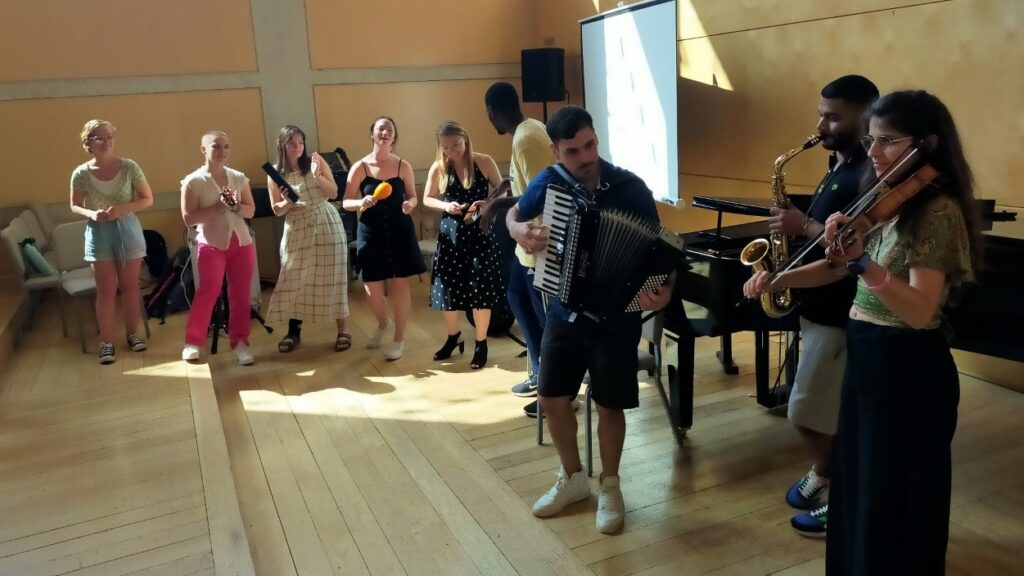
Master’s Degree in Music Therapy
| ECTS Credits | 120 |
| Available places | 15 |
| Calendar | October 2, 2026 - June 19, 2027 |
| Timetable | Week with face-to-face classes: 1 weekend per month Friday, from 18:00 to 21:00 Saturday, from 9.30 to 15:00 Sunday, from 9:30 to 13:30 Week with online classes: 3 weekends per month Friday, from 18:00 to 21:00 Saturday, from 9:30 to 15:00 |
| Teaching language | Catalan, Spanish, English |
| Modality | Online / In-person |
| Price/credit | 52,50€ Payment distributed in two years (4 payments per year) |
Informative Meeting (Online): April 9, 2026 – 7:00 PM
Meeting access link
Registration calendar
| MASTER’S PRE-ENROLMENT ACADEMIC YEAR 2026–2027 | |||
|---|---|---|---|
| Acceptance of candidates | |||
| 1st round | From February 2 to March 25 | April 15 | |
| 2nd round | From May 4 to May 24 | June 9 | |
| 3rd round | From July 6 to September 6 | From September 6 to 13 | |
| 1st round enrolment: Once the pre-enrolment has been accepted, from April 22 to April 29 | |||
| 2nd round enrolment: Once the pre-enrolment has been accepted, from June 17 to June 25 | |||
| 3rd round enrolment: Once the pre-enrolment has been accepted, from September 14 to 18 | |||
| Pre-enrolling in the first call gives you more time to complete the different administrative procedures. We recommend not waiting until the last days of each deadline in order to have enough time in case any document is missing. Applications will be answered within a maximum period of ten working days. Once the pre-enrolment has been completed and validated by the corresponding Master’s Management Units, it will be forwarded to the coordination teams and academic directors of each Master’s programme for assessment, selection and, if applicable, authorisation of enrolment. |
|||
| MASTER’S ENROLMENT ACADEMIC YEAR 2026–27 | |||
| 2nd year | From July 20 to July 23 | Online Start: 9:00 a.m. End: 11:59 p.m. Telephone support, working days from 9:00 a.m. to 2:00 p.m. |
|
| 1st year | From April 22 to April 29 From June 17 to June 25 |
||
Music is inherent to the human being and is a means of expression, development, health and cohesion. Music therapy is a scientifically based discipline that consists of using music to improve the lives of people with particular needs in the educational, medical-hospital and social-community fields.
This Master of Music Therapy is designed for the following people:
At ESMUC, students will acquire the skills that will help them develop as music therapists and will experience the field of the profession from the first day, beside active professionals and the best teachers and researchers in each specialty.
Students of this master’s degree have at their disposal study areas, recording rooms, a wide variety of instruments, the Library and Resource Centre for Learning and Research (CRAI) with many documents related to music and interrelated disciplines. Students can also participate actively in musical activities and other experiences offered by ESMUC.
In order to obtain the qualification of Master in Music Therapy (120 ECTS) you must already have a degree. However, students who are still in the last year of a degree course can apply for a place, and can obtain the qualification of Master in Music Therapy provided they finish their degree course. Without a degree qualification, the student will only be given a certificate of results.
In addition to the general access requirements for all master’s degrees, future students must show:
For the assessment of musical skills, the following criteria will apply:
In addition to musical skills, Students must be able to understand and read English.
Applicants are also asked for the following:
This master’s degree is completed in two academic years, part-time, following the training criteria recommended by the European Music Therapy Confederation (EMTC) and the World Federation of Music Therapy (WFMT). It has a total of 120 ECTS and the study program consists of the following subjects:
| Subject | Year/Semester | ECTS |
|---|---|---|
| 1. Theoretical foundations of Music Therapy | ||
| Introduction to music therapy | 1/1S | 4 |
| Psychological and neuroscientific bases of Music Therapy | 1/1S | 4 |
| Introduction to Music Therapy research | 2/Annual | 4 |
| 2. Methodological foundations of music therapy | ||
| Application of Music Therapy in the different fields of intervention: educational, medical-hospital and social-community fields | 1/Annual | 16 |
| Working models in Music Therapy with self-experience | 2/Annual | 12 |
| Professional aspects of music therapy | 2/Annual | 4 |
| 3. Musical and technological resources in Music Therapy | ||
| Relationship of assistance and self-experience | 1/Annual | 3 |
| Psychopathology | 1/2S | 4 |
| Psychotherapies - Psychotherapeutic models | 2/Annual | 8 |
| 4. Music, body and technology resources in Music Therapy | ||
| Functional instrumental training: piano, guitar, voice | 1/Annual | 20 |
| Body techniques in the clinical context | 1/2S | 4 |
| Training and practice of ensembles | 2/Annual | 4 |
| Technological resources: Basic tools and clinical applications | 2/1S | 2 |
| Composition / Improvisation in Music Therapy | 2/Annual | 6 |
| 5. External practicum | ||
| External practicum I | 1/Annual | 4 |
| External practicum II | 2/Annual | 8 |
| Final Project | ||
| Final project | 2/Annual | 12 |
The principal objective of this master’s degree is to train professional music therapists, in an environment surrounded by high quality music, so that they can work and develop independently in a variety of educational, medical-hospital and socio-community contexts.
The learning process that students will carry out in this master’s degree should ensure their professional competence together with the empowerment and optimization of their personal development. The training offers future specialists the knowledge and theoretical and practical skills that they will need in professional practice, as well as the methodological rigor and the attitude of constant self-improvement that will lead them to be agents of the development of the profession. Continuing education is essential for this profession, which is constantly evolving.
Through this master:
The music therapist must be able to work with people of any age with needs in the educational, medical-hospital or socio-community fields.
In all these fields, the necessary skills of a professional music therapist can be defined in three areas:
Musical competence
Competence in the musical field includes: skilled use of accompanying instruments; skilled use of the voice; ability in improvisation, conducting ensembles, composition and arrangements; knowledge of a variety of repertoire and musical styles; ability to apply basic music technology to the clinical context; and knowledge of pedagogical techniques related to musical teaching that allow adaptation to different functional levels of the participants.
Clinical competence
Clinical competence includes: empathy; the ability to observe from an ethical and respectful perspective; understanding of a helping relationship and psychotherapeutic techniques in specific groups; ability to evaluate, design and plan treatment; and good communication and teamwork.
Music Therapy competence
Music therapy competence includes: self-experience, knowledge of the psychological and neuroscientific bases of Music Therapy; understanding of the theoretical foundations of Music Therapy; familiarization with the different methodological orientations; knowledge of the scientific literature on the subject; familiarity with Music Therapy techniques used of specific environments and groups, and the ability to apply them in clinical contexts through practices.
The professional opportunities of a trained music therapist are very broad, given the diversity of the educational, medical-hospital and social-community fields in which Music Therapy is applied. Thus, people who have completed the ESMUC master’s degree may work in:
Coordination: Dra. Melissa Mercadal
This master’s degree has the collaboration and participation of many music therapist professors with specialization and a long professional career and who are fully active in clinical practice and research.
The structure and organization of the classes is fully integrated in the framework of the European Higher Education Area (EHEA), with the aim that students combine different abilities: the reception of information through theoretical classes the learning of technical skills through practical work, and personal introspection through experiences and reflections on appropriate attitudes and behavior in order to adapt to the needs and demands of the environment. We share and defend the importance of addressing the human dimension, both in terms of the type of problems being treated, and in terms of the human component present in any therapeutic action.
In addition, each year, other nationally and internationally recognized professors are invited to give seminars, master classes, specific monographs, participate in seminars and training workshops.
As a starting point, a music therapist is a person and a professional with a great love for music, and who is committed to using it for therapeutic purposes, within a helping relationship, with people who present a need for some sort of support.
This master’s degree is aimed at:
The Escola Superior de Música de Catalunya (ESMUC) has Erasmus agreements with more than 70 European centres, thus allowing the exchange of students and teachers from various Music Therapy programs: Guildhall School of Music; Vienna University of Music and Dramatic Art; Norwegian Academy of Music; Institut Kódaly (Hongria), among others.
In the field of Music Therapy, the international academic and practical training programmes work closely together and the students benefit from this joint work and exchange.
Relations are also maintained with North American centres such as Western Michigan University (WMU-USA), West Virginia University (WVU-USA); Seattle Pacific University, Indiana University-Purdue University (IUPUI), in USA and the Center for Music Therapy in End of Life Care, Florida, USA, to facilitate exchange of faculty and students. In addition, students from foreign universities who wish to carry out their internship supervised by professional music therapists from ESMUC are welcomed.
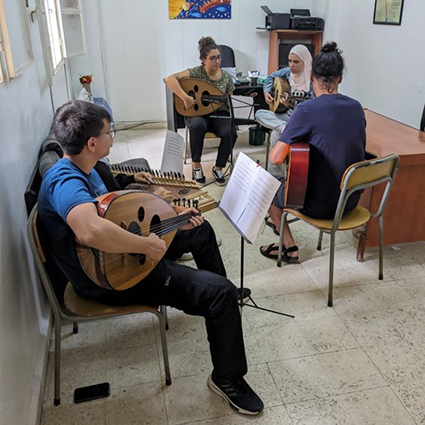
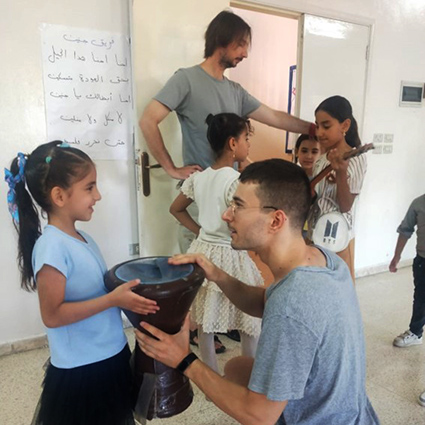
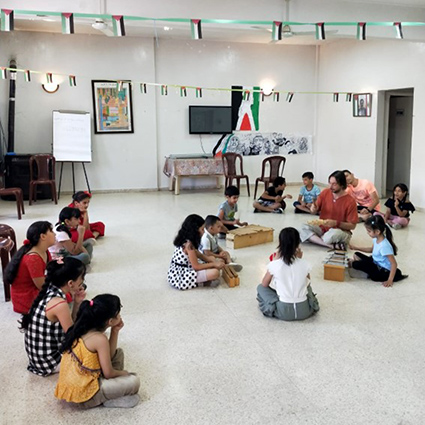
Community Music activities, psychosocial intervention in music, and Music Therapy in Palestinian refugee camps in Lebanon.
A project of International Cooperation led by the Social Promotion Association Prima Materia (Italy) in collaboration with the Palestinian-Lebanese partner NISCVT, National Institution of Social Care and Vocational Training “Beit Atfal Assumoud” (“House of the Resilient Children”).
Other projects:
These exchanges make it possible to experience first-hand the practice of this discipline from diverse cultural realities.